Most plants that install andon end up measuring the wrong thing. They count calls. A dashboard shows “42 andon calls this week,” someone nods, and the number becomes a fact about the floor instead of a fact about how often someone pushed a button. It says nothing about what happened after the button was pushed, which is the only part that was ever the point.
An andon call is a question: is anyone coming. The system that matters isn’t the light or the button, it’s whatever answers that question, and how fast.
Counting calls measures the wrong end of the problem
A call count goes up for reasons that have nothing to do with how well the plant responds. More calls can mean more problems, or it can mean operators finally trust the button enough to use it, which is a good thing wearing the same number as a bad thing. A call count going down can mean the floor got better, or it can mean an andon that takes twenty minutes to get answered has taught everyone to stop calling and just wait, or walk over and get someone themselves. Either way the count drops and the dashboard looks like progress.
None of that is visible in a raw total. What’s visible in a raw total is exactly one thing: how many times a button got pushed. Everything a plant manager actually wants to know, whether help showed up, how fast, and whether the same station is calling for the same reason every shift, lives downstream of that number, not in it.
What “answered” actually means
A call has to go somewhere specific, or “answered” is just a word. On a claimed station, the Help tile lets an operator raise a request against a category, Maintenance, Material, Quality, or Other, without leaving the machine, and see the status of their own open requests right there. That request becomes one record with one lifecycle: open, then in progress once someone picks it up, then resolved. Every step gets its own timestamp, so the record shows exactly how long each stage actually took, not how long someone remembers it taking.
Opening a call also lights that machine’s tower light or beacon if it has one, red for the open call, amber once someone’s acknowledged it and is on the way, off once it’s resolved, a change anyone walking the floor can read without opening an app. Nothing about that light ever touches the machine’s own controller, it’s Spall’s own hardware sitting next to it, purely a signal.
Time to acknowledge is the number that actually tells you something
Every open work item carries its age, live, right up until it moves to the next stage, and that age is what actually measures an andon system: how long a call sat waiting once it came in. A plant with forty calls a week and a two minute average acknowledge time is running a healthier floor than one with ten calls a week and a twenty minute average, even though the second plant’s dashboard looks quieter.
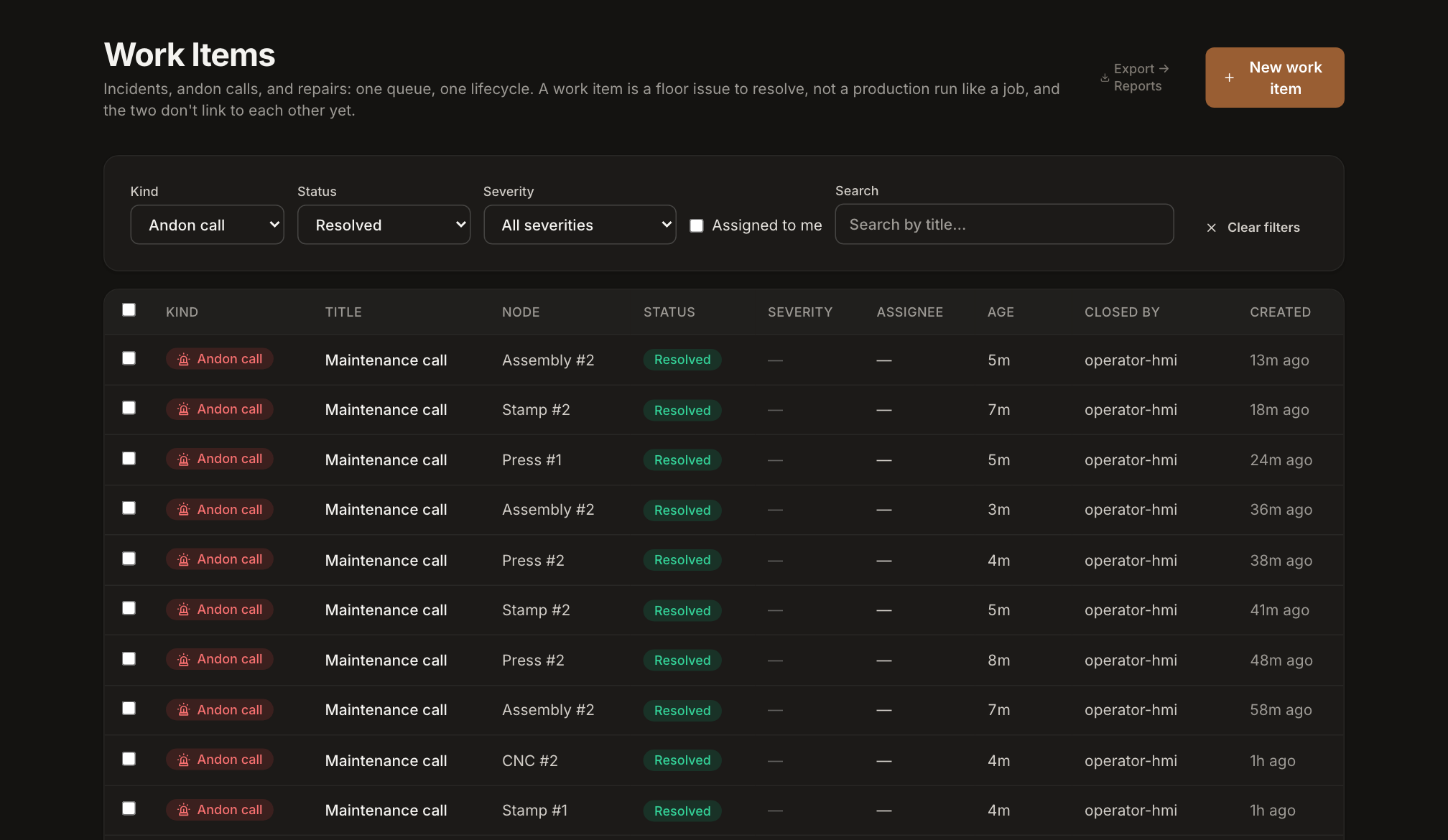
The screenshot below is a real filtered view: andon calls, resolved, from a working plant. Every row shows how long the call actually took to close, five minutes, seven minutes, three minutes, and who closed it, credited by the station that answered, not a name attached to a personal scoreboard.
That age is also where accountability lives without turning into a blame log. A plant can set a per-severity time threshold, off by default, and an item that ages past it gets marked and its assignee or group re-notified once, automatically. If nobody’s assigned yet, it still gets marked as having aged past its threshold, a fact about a gap in coverage, not a resolution invented to make it look covered. The point was never to catch a person being slow. It’s to catch a call that’s sitting with no one coming, while it’s still fixable, instead of finding out at the end of the shift.
Answering fast is not the same as fixing fast
None of this promises a repair happens quickly, and it shouldn’t pretend to. Acknowledging a call means someone is now accountable for it and headed that way, not that the machine is running again. A five minute acknowledge time on a bearing that takes four hours to source and replace is still a five minute acknowledge time, and a legitimate one. Conflating the two numbers is how a plant ends up gaming the metric, tapping “acknowledged” from a desk without walking over, just to keep the clock looking good.
The fix is not asking the acknowledge number to do a repair number’s job. Time to acknowledge answers “did anyone respond.” Once a stop is actually being worked, that’s a different lifecycle with its own clock, the same aging and escalation logic applied to a real fix, and its own measures, mean time to repair and mean time between failures, both rendered as a dash when there isn’t enough data yet to say. Track both, and neither one can hide behind the other.
Where this actually pays off
A station that calls for help every shift for the same reason isn’t a mystery once the record exists to show it. The call, the category, the machine, and how long it sat, all logged automatically the moment the button gets pushed, no clipboard and no end of shift reconstruction from memory. Patterns that used to live only in a supervisor’s head, that press always jams on the same product, that one line always calls for material at the same point in the shift, show up in the data because every call is a timestamped record instead of a story someone tells later, the same discipline behind Downtime Reason Codes Operators Will Actually Use applied to a call for help instead of a stop.
Watchers extend that without diluting who’s actually responsible. A manager can follow a repeat offender’s calls without owning the response, and the whole maintenance team can watch every call from a given line, so the right people see the pattern building in real time instead of hearing about it secondhand a week later. One assignee still owns each call. Any number of people can watch it.
Quick recap
- A raw andon call count can go up for good reasons and down for bad ones, it never tells you which
- What matters is what happens after the button is pushed: a call becomes one tracked item with one lifecycle, timestamped at every stage
- Time to acknowledge, not the call total, is what actually shows whether an andon system works
- Per-severity SLA thresholds catch a call with nobody coming, even when nobody’s assigned yet
- Acknowledging isn’t repairing, track both and let neither one hide behind the other
- The payoff is pattern visibility: which station calls for what, and how often, without anyone reconstructing it from memory