AI that learns how your plant operates
How Spall learns your plant.
Spall learns each machine's normal from its own signals, prices every loss at your rates, and answers questions about the plant with the evidence attached. No setup, no thresholds to tune, nothing to configure before it starts watching.
What it learns
A model per machine, built from what it already sends.
A per-machine model of normal
Telemetry shape, not brand or protocol, decides what gets modeled. The same learning runs whether the signal came off a Siemens PLC, a FANUC control, or a clamp-on sensor with no controller behind it at all.
Golden runs
The best sustained cycle time an asset has actually produced over its own training window, so a slower cycle today has a real baseline to be measured against.
Alarm sequences that precede stops
Which alarm codes, and how many times, tend to fire in the hours before a downtime reason or a scrap event, so a pattern can be flagged before the next stop repeats it.
Cycle drift
How far a running program or product is drifting from its own golden run, priced per week.
How often each machine fails
Mean time between real breakdowns, built from the machine's own failure and repair history, and whether that pace is getting worse or better.
The drivers behind each loss
The features behind a finding, in plain language, next to the finding itself, not buried in a model nobody can read.
What it does with it
Every finding lands as a dollar, an action, or an answer.
Ranked losses, in dollars
The same Opportunities board that ranks downtime and scrap by cost, at your own rates, with the evidence attached to every row.
A failure risk for the days ahead
Each machine gets a chance of a breakdown over the next 7 days, estimated from its own failure history, with the count of failures behind the number. A machine with too few failures to trust the estimate is held back instead of guessed at.
Proposed triggers, one click to accept
When a precursor pattern is strong enough, the model proposes the rule itself, prefilled into the same rule-authoring flow a person would use.
Answers with sources
A plain-language question is routed to the bounded slice of your own data most likely to hold the answer (maintenance tickets, downtime, rate, cost, quality, jobs, shift notes, shift and machine combinations, gateway health, or open alerts), and the answer lists exactly what it read. Ask "which machine is most likely to fail" or "why was OEE down" and get the same sourced answer.
A ledger that measures whether a fix held
Linking an insight to an action opens a before and after measurement window. The ledger reports what changed, and says so when a fix did not hold.
Use Spall from your own AI
Claude, Copilot, or Cursor, reading straight from your plant.
npx @spall/mcp adds
fourteen read-only tools to Claude Desktop, Cursor, or Copilot, each one a direct call to the same
public API the rest of this page describes. Ask your own assistant about your plant and it answers
from live data, with the same sourcing the app itself shows.
The fourteen tools
list_assets · get_oee · get_opportunities · get_downtime_pareto · get_downtime_events · get_quality_summary · get_alerts · get_work_orders · get_pm_tasks · get_failure_risk · get_ledger · get_insights · get_golden_runs · ask_factory
Every tool is a read. None of them creates a rule, edits a work item, or writes to a machine.
ask_factory is the one
tool that calls Spall's own AI, it needs a key with the ask scope and draws against a per-key daily
question budget, a plain message once that budget is spent for the day. Every other tool runs under
your key's normal rate limit.
What it never does
The rules that do not change.
No forecast without evidence
A failure risk shows the failure count and the mean time between failures it was built from, next to the percentage, never a bare number.
No writes to a machine
Spall reads from your machines. It never writes to one.
No black box
Every card shows the evidence behind it, and a model that has not seen enough history yet says "not enough history" instead of guessing.
Ask your factory
Ask a plain question, get an answer with sources.
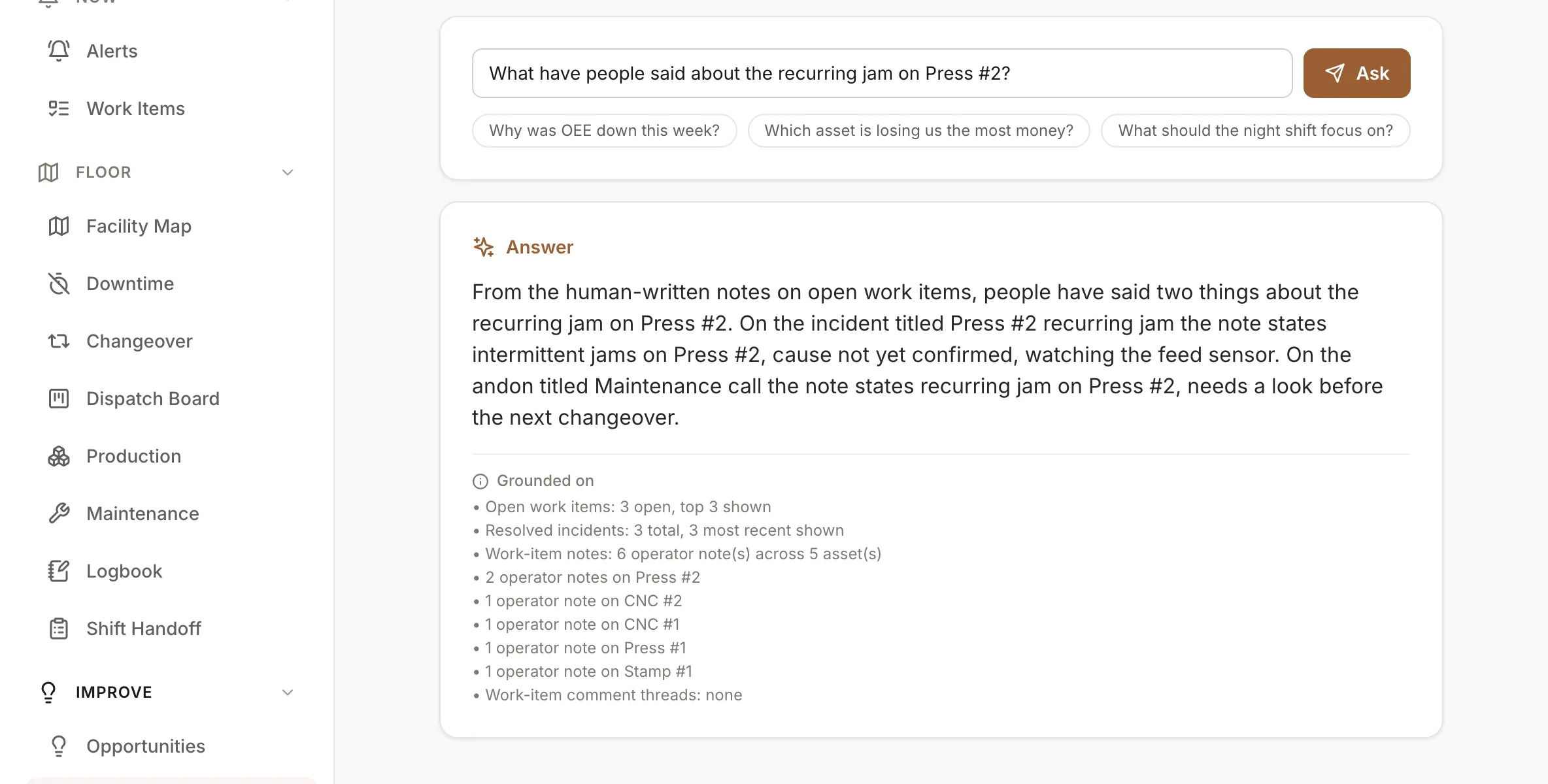
Questions you can ask
Why was OEE down this week?
Which asset is losing us the most money?
What should the night shift focus on?
How is Press 1 running against its target rate?
What maintenance tickets are still open?
Which jobs are behind schedule?
What do the shift notes say about the recurring jam on Line 2?
Is quality worse on nights than on days?
Which gateway has not reported in?
What critical alerts are open right now?
See it answer
Six questions, answered live.
Six plant-manager questions on the demo tenant, including a follow-up. Pauses shortened for the recording. Sound on, or read the captions.
See it learn your own machines
A 30-day pilot on one line, hardware included.
Pilots from $4,500, credited in full when you make the decision to implement. We mount the gateway, and the models start learning from the first signal it reads.