How Spall fits next to what you already have
Where they win. Where we win.
SCADA, point-OEE tools, and MES all solve something real. Here's where each one fits next to Spall, matchup by matchup.
vs. SCADA platforms
vs. SCADA platforms like Ignition
Their pitch: A fully flexible industrial platform, a large network of integrators to build it for you, and no limit on how many data points or users you add.
Where they win
- ▸ Building a custom control system from scratch, with your own controls team or an integrator
- ▸ A plant with an in-house controls team that wants a flexible toolkit to build on
- ▸ Sending commands back to equipment, like changing a setpoint from the software: Spall only reads data, it never writes to a machine
Where we win
- ▸ Time to first result: Live in an afternoon, not months. No integrator required: a guided setup checks the connection itself as you go.
- ▸ Total cost: A SCADA license is the cheap part. Paying an integrator to build the project on top of it is the real cost. A typical Spall setup runs around a tenth of a typical SCADA project's first-year total.
- ▸ What you get on day one: A SCADA platform gives you a blank screen to build on. Spall arrives with the OEE math, the AI, the cost model, and the wallboards already built.
- ▸ The built-in AI: Finding which signals are worth watching, seeing how a setpoint change affects output, spotting your best-ever run, and estimating failure risk from each machine's own repair history all come standard. None of it exists in a SCADA platform without a separate project to build it.
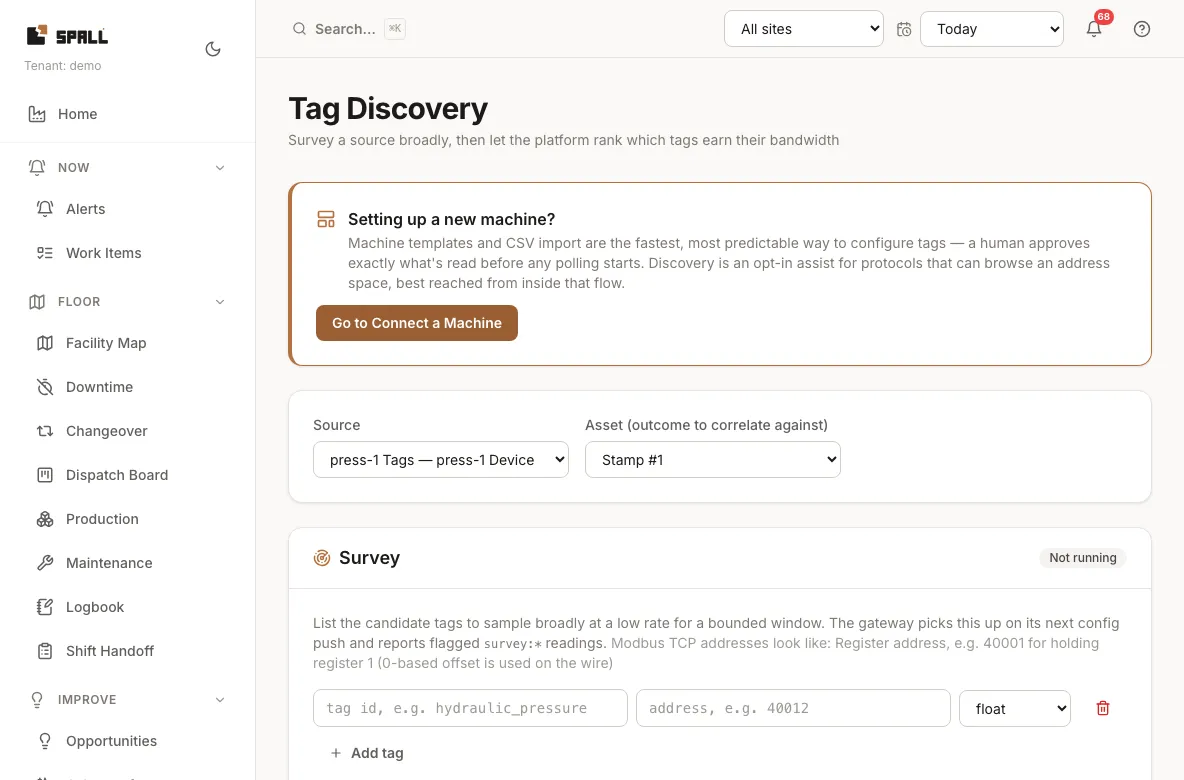
Proof screen: point Tag Discovery at a machine, tell it what outcome you care about, and it ranks which signals are worth watching. A SCADA toolkit can't do that until you configure it yourself.
vs. other OEE tools
vs. other OEE monitoring tools
Their pitch: Clip-on sensors or a simple connection get an OEE dashboard running fast, priced per machine.
Where they win
- ▸ The simplest possible setup, if all you want is one number per machine
- ▸ No electrical panel access needed: their sensor clamps around a power cord and you can install it yourself in minutes. A Spall gateway is wired in by our technician during setup
Where we win
- ▸ Reads the machine, not a guess: Spall reads data directly from the machine's own controls (OPC-UA, Siemens, Allen-Bradley, Modbus, FANUC, and more), instead of estimating it from a current clamp on the power cord. If a machine has no controller at all, a wired sensor gets the same data. Utilization is one of many numbers Spall computes. Most point tools stop there.
- ▸ One bill, whole bill: The price you see includes the gateway, our technician installing it, cellular data, and the full AI. Many competing quotes leave out an activation fee, hardware, or setup labor. All-in cost: connected machines $200/mo each ($160 from the 11th), sensed-only machines $125 flat.
- ▸ A vendor that still answers the phone: Several names in this category changed owners in the last year (Scytec was bought by Minitab, Amper by ECI Software). That kind of consolidation is common, but it is worth asking any vendor, including us, who owns the roadmap now and what happens to the entry-level plans.
- ▸ Depth past the dashboard: A detailed history of what happened before and after each event, andon call lights, preventive maintenance, checklists, a logbook, job costing, and energy tracking are all included. Most point-OEE tools stop at the chart.
- ▸ Findings priced in dollars: Every finding shows up as a dollar figure, using your own labor, scrap, and energy rates, not a generic estimate.
- ▸ Your data, out anytime: Your data connects live to Excel, to a database, and through an API, so you can pull it out whenever you want. Ask another vendor how you would get your raw data out and compare the answer.
vs. Enterprise MES
vs. enterprise MES
Their pitch: A manufacturing execution system (MES) covers the full plant end to end: quality, traceability, scheduling, product genealogy, and compliance records.
Where they win
- ▸ A regulated industry that needs full traceability of every part, like pharmaceuticals or aerospace
- ▸ Complex production scheduling and tracking parts back through every step they went through
- ▸ Running jobs directly inside your ERP as the official system of record
Where we win
- ▸ A budget you can approve yourself: Roughly $18,000 a year for a typical plant with Spall, against $250,000 or more in the first year for a typical MES project, a number a plant manager can approve without a capital budget process.
- ▸ Live in a day, value in a week: Against a 6 to 12 month rollout with a consultant team for a typical MES project.
- ▸ Built for the mid-market: Spall gives a mid-size factory visibility and analysis on the floor, and connects out to other systems through an API. It does not try to become your MES.
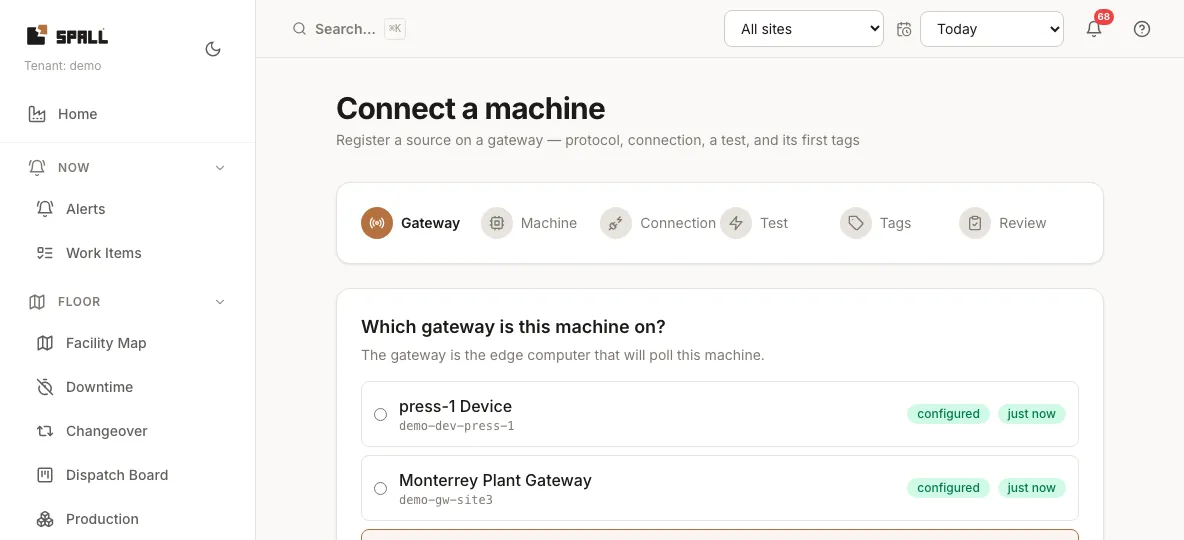
Proof screen: the guided setup you can finish on day one, followed by a live wallboard the same day.
vs. named point-OEE vendors
If you're comparing us by name
Five names come up most in point-OEE evaluations. Each is good at something specific, described below. Every claim links to the vendor's own public source.
MachineMetrics
The pure-play benchmark
MachineMetrics covers more ground than most machine-monitoring vendors, closer to a full manufacturing execution system with production scheduling built in. If you want monitoring and scheduling from one vendor with a direct connection into your ERP, they are worth a look.
Where we differ
- ▸ What connects out of the box: Spall connects directly to 18 kinds of industrial equipment, including Siemens, Allen-Bradley, Omron, Mitsubishi, and LS Electric controls, PLCs, CNCs, and sensors. Check your own machine list against the table at /protocols before you talk to anyone.
- ▸ Pricing on the site: Connected machines run $200/mo each, dropping to $160 from the 11th machine. Sensed-only machines are $125 flat. You can see the number without booking a demo.
- ▸ No write access to your machines: Spall only reads data from your machines. It never sends a command back to a controller, and there is no setting that turns that on.
- ▸ 30-day pilot: A 30-day pilot includes the hardware, credited against your first invoice if you continue: line pilot $4,500, plant pilot $8,500.
Sources: MachineMetrics, Pricing MachineMetrics, Integrations MachineMetrics, Connectivity MachineMetrics, Series B announcement
Read the full MachineMetrics comparison →Scytec DataXchange
Pure-play CNC OEE
Scytec DataXchange is built first for CNC shops, with published pricing that is more transparent than most in this category. It is one of the few names here that runs on your own servers as well as the cloud, for a shop that can't put its data online at all.
Where we differ
- ▸ Findings ranked by dollar impact: Spall ranks where you're losing capacity in dollars, using your own rates, and shows the reading each number is based on. When there isn't enough data yet, it says so instead of guessing.
- ▸ Beyond CNC: Spall connects to CNC machines the same way Scytec does, plus Allen-Bradley, Siemens, Omron, Mitsubishi, and LS Electric controls. A plant that mixes CNC with presses, molding, or assembly lines is one system, not two.
- ▸ Depth past the dashboard: A detailed history of what happened before and after each event, andon call lights, preventive maintenance, checklists, a logbook, job costing, and energy tracking all come in the base product.
- ▸ 30-day pilot: A 30-day pilot includes the hardware, credited against your first invoice if you continue: line pilot $4,500, plant pilot $8,500. There's no setup fee before you've seen a result.
Sources: Scytec, DataXchange Pricing Scytec, Compare License Levels Scytec, DataXchange Overview Scytec, Minitab acquisition announcement
Read the full Scytec DataXchange comparison →Guidewheel
Clamp-on "FactoryOps"
Guidewheel's install avoids the PLC entirely: a clamp-on sensor with no controls work and no IT involved. It is a well-funded, independent company in this category, with energy and carbon reporting built out further than most others here.
Where we differ
- ▸ Reads straight from the controller: Spall reads part counts, cycle times, alarm codes, and machine status directly from the controller, over the machine's own protocols (OPC-UA, Siemens, Allen-Bradley, Omron, Mitsubishi, and more). If a machine has no controller at all, a wired sensor gets the same data.
- ▸ Every finding priced in dollars: Every finding shows a dollar figure, calculated from your own labor, scrap, and energy rates, next to the reading it's based on.
- ▸ Depth past the dashboard: A detailed history of what happened around each event, andon call lights, preventive maintenance, checklists, a logbook, job costing, and energy tracking all come in the product.
- ▸ 30-day pilot: A 30-day pilot includes the hardware, credited against your first invoice if you continue: line pilot $4,500, plant pilot $8,500.
Sources: Guidewheel, Pricing Businesswire, Guidewheel Series B announcement Guidewheel, Reduce Energy Costs
Read the full Guidewheel comparison →Evocon
The price-transparency benchmark
Evocon publishes its pricing to the dollar, with unlimited users on every plan and a free trial, more price transparency than most others in this category.
Where we differ
- ▸ One bill, whole bill: Spall's published price includes the gateway, our technician installing it, cellular data, and the full AI. Nothing gets added later for hardware or integration.
- ▸ Own the gateway: The gateway is a one-time $1,500 purchase, credited against your bill when you add more machines.
- ▸ AI included on every plan: The AI features are included in the plan you're already paying for. There's no separate plan or fee for them.
- ▸ Protocols you can check yourself: Spall lists 18 protocols across PLC, CNC, and sensor families by name, with a table at /protocols so you can check your own machines before you call.
Sources: Evocon, Pricing Evocon, homepage
Read the full Evocon comparison →Amper
Clamp-on current sensing, no PLC
Amper, now part of ECI Software Solutions, built one of the easiest installs in this category and has expanded beyond monitoring into scheduling, an operator interface, and issue tracking.
Where we differ
- ▸ Reads straight from the controller: Spall reads part counts, alarm codes, program status, and spindle load directly from the controller, over the machine's own protocols, not a current-clamp estimate.
- ▸ Every finding priced in dollars: Every finding shows a dollar figure, calculated from your own rates, next to the reading it's based on. When there isn't enough data yet, it says so instead of guessing.
- ▸ Pricing on the site: Connected machines run $200/mo each, dropping to $160 from the 11th machine. Sensed-only machines are $125 flat. The price is published up front, no demo needed to see it.
- ▸ 30-day pilot: A 30-day pilot includes the hardware, credited against your first invoice if you continue: line pilot $4,500, plant pilot $8,500.
Sources: ECI Software Solutions, Amper product page ECI Software Solutions, Amper Features ECI Software Solutions, acquisition announcement
Read the full Amper comparison →Vendor names identify who we're compared to, nothing more. Every fact above is drawn from each vendor's own published pricing and product pages. Where a vendor doesn't publish something, the card says so instead of estimating.
Common questions
- Is Spall a replacement for SCADA, point-OEE tools, or an MES?
- Spall reads machines natively like a SCADA platform and ships OEE and AI out of the box like point-OEE SaaS. It does not cover an MES's scheduling, genealogy, or compliance scope.
- How is the named-vendor comparison sourced?
- Each competitor statement links to that vendor's own pricing or product page.
- What's the fastest way to see which column we're in?
- A pilot: 30 days, hardware included, line pilot $4,500 or plant pilot $8,500, fully credited if you expand.
The fastest way to know which column you're in.
30 days, hardware included, line pilot $4,500 or plant pilot $8,500, fully credited when you expand.